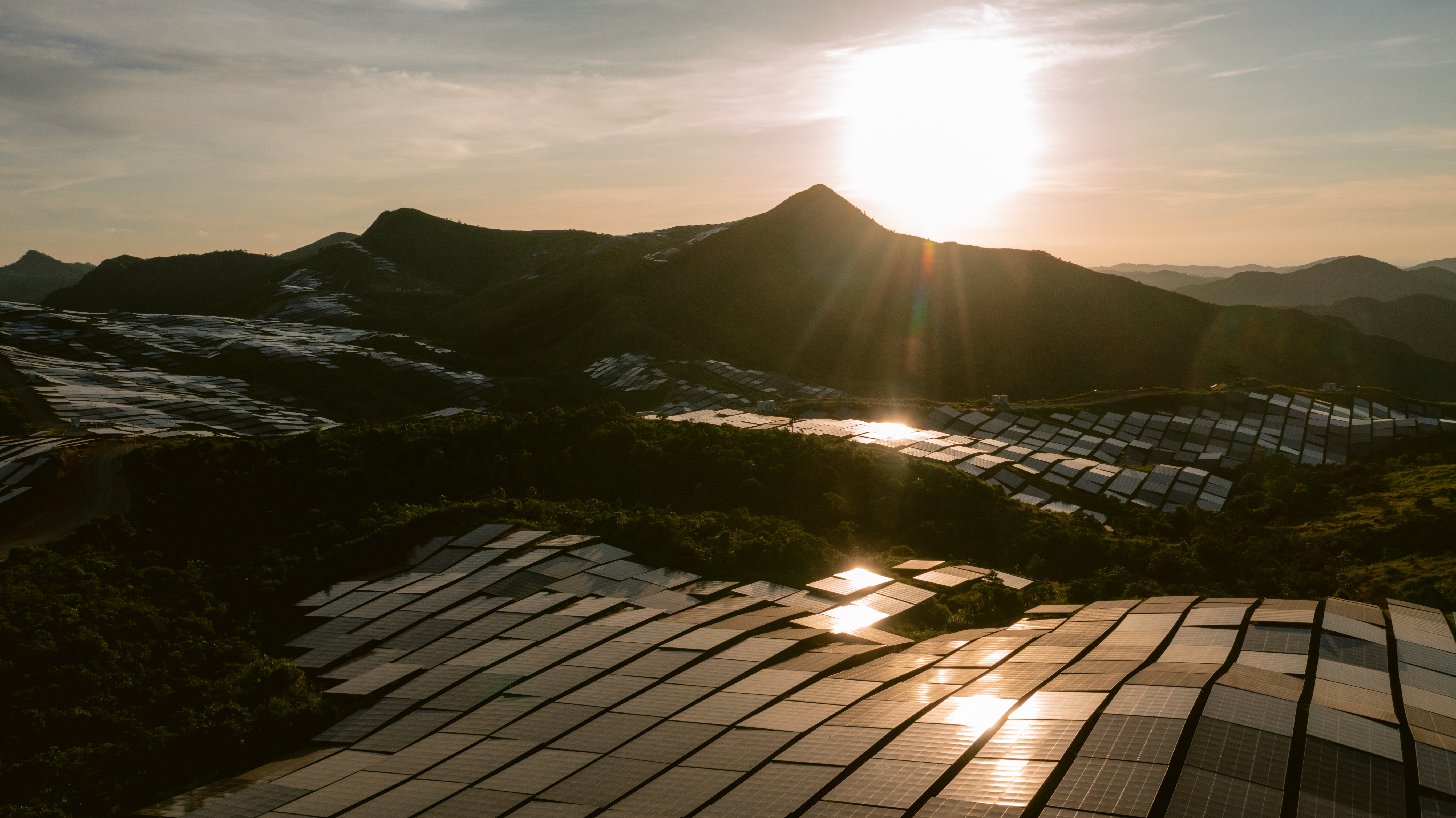
AboitizPower’s 94-megawatt peak Cayanga-Bugallon solar power plant in Pangasinan.
“Wine is sunlight, held together by water,” the great Italian polymath Galileo Galilei purportedly once said. It points to the connectedness of all things; in that case between the sun, the vine, and the resulting wine, connected together through photosynthesis and the art and science of vinification.
Today, the wine supply chain network of production, storage, transportation, and distribution is wider and grander, all made possible through technology, global trade, and the energy systems that power it all.
In recent years, solar power itself has seen an increasing role in global power generation. According to the International Energy Agency (IEA), while solar PV (photovoltaic) still accounts for just 7% of global electricity generation, “global generation from solar PV has been doubling approximately every three years since 2016, and it did so again between 2021 and 2024.” As of that year, an estimated total of 2.2 terawatts or about 2,200,000 megawatts of installed capacity worldwide is solar PV, which generated over 2,000 terawatt hours or 2,000,000,000 megawatt hours of electricity.
In the Philippines, solar accounts for 2,710 megawatts, or 9.1%, of its installed capacity and 3,810,693 megawatt hours, or 3%, of its gross power generation, according to the Department of Energy’s 2024 Power Statistics. It has rapidly grown in recent years as underscored by the fact that solar currently comprises almost a fifth of the total capacity mix within the 0-10 year age bracket. Under its reference and clean energy scenarios, the Philippine Energy Plan projects a rise to over 10,000 megawatts of installed solar capacity by 2030, supported by the Green Energy Auction (GEA) program. The fourth round or GEA-4, which is the most recent iteration, auctioned off over 9,400 megawatts of rooftop solar, ground-mounted solar, and floating solar capacity, among others. Harnessing sunlight has certainly come a long way.
But even before solar PVs, Galileo, and wine, the sun has long been a part of the history of energy. A colleague once pointed out that just about all of our energy comes from the sun. Fossil fuels come from living organisms — prehistoric plants and animals — nourished by the sun millions of years ago. The wind cycle works because of the sun’s uneven heating of the Earth’s surface. Then, through the wind and its sheer gravitational pull, the sun influences waves and tides as well. Moreover, the water cycle that makes rain possible, which in turn feeds rivers with flowing water, is also driven by the sun through evaporation.
Just by looking at society’s power generation mix, it can further be inferred that any individual energy source is almost always important to the fate of the other, and cannot provide the full utility of continuous power generation on its own. In the Philippines, there is a reason why it cannot pursue 100% renewable energy, much less 100% solar, in its power generation mix. In a systems view, solar PVs need other sources of energy or even battery storage to fill the power demand gap when there is insufficient sunlight or when it's nighttime. In fact, its capacity factor — or the ratio between actual power generation and full rated capacity — was tallied at 20% in 2023, according to the Philippine Electricity Market Corporation. That means for every 100-MW of installed capacity, only 20 MW is effectively produced. Power plants with higher capacity factors like geothermal (65-71%), coal (58-69%), natural gas (44.2-64.2%), and hydro (24.1-39.2%) are needed to balance the mix and provide electricity when and where it’s needed.
To refine and extrapolate Galileo’s initial observation on wine and sunlight: our electricity is any specific energy source (e.g. hydro, wind, solar), held together by the other sources of energy (e.g. geothermal, coal, natural gas), and vice versa. Nowadays, especially with more variable power sources, even batteries are in the mix, which allows us to “bottle the sun”, so to speak, and use the energy for a later time when needed.
Such is the reality that a blend of energy sources and technologies are needed to keep the lights on 24/7 at the flick of a switch, powering society and economy. Much like wine, the preferable blend is one that is palatable to the taster, and tailored to his specifications and needs. So whenever we use electricity or energy, think about the sun as it is likely the source; but also consider how a confluence of many things — from the natural to the man-made — are making it all possible.