What We Do
As one of the Philippines’ largest energy producers, we are committed to providing the nation with reliable, affordable, and sustainable power sources.

AboitizPower recognizes the importance of environmental sustainability and the power industry’s impact on our planet, given that energy production relies on the Earth’s natural resources. But as we take, we must also give back.
As one of the nation’s top renewable energy providers and environmental partners, we play a crucial role in conservation efforts to minimize the adverse global effects of power businesses. These include complying with government regulations, third-party evaluations, efficient use of resources such as water and energy, proper waste management, and environmental advocacy campaigns.
AboitizPower’s parent company, Aboitiz Equity Ventures (AEV), is a member of the United Nations Global Compact (UNGC). AboitizPower ensures that its efforts and programs are aligned with AEV’s principles. The Company takes a precautionary approach to addressing environmental challenges, ensuring that programs and initiatives promote environmental responsibility and continue to develop and disseminate environmentally friendly technologies, such as our renewable energy capabilities.
The future we’re building is only as good as our current decisions. We only have one planet. Let’s strive to take care of it.

Environmental sustainability involves conserving our natural resources and protecting the environment to preserve it for future generations.
Our environmental sustainability efforts focus on meeting current needs without compromising the ability of future generations to meet greater demands. Through our environmental initiatives, such as tree planting, coastal cleanups, and biodiversity conservation, we can make the “Better World” we hope for a reality.
AboitizPower is one of the largest renewable energy providers in the Philippines. We have taken steps to ensure that our footprint and impact are managed responsibly, driving our pursuit of sustainability and conservation. Read more about AboitizPower’s full Environmental Policy.
The company complies with various environmental laws in the Philippines, such as the Presidential Decree 1586: Philippine Environmental Impact Statement System and its Implementing Rules and Regulations (IRR), Republic Act No. 9275 - Philippine Clean Water Act of 2004, Republic Act No. 8749 - Philippine Clean Air Act of 1999, Republic Act No. 6969 - Toxic Substances and Hazardous and Nuclear Wastes Control Act of 1990, Republic Act No. 9003 - Ecological Solid Waste Management Act of 2000, DAO 2014 - 02: Revised Guidelines for Pollution Control Officer Accreditation, among other relevant environmental requirements.
Our Operationally Controlled subsidiaries hold ISO 14001:2015 Environmental Management System certifications as part of our efforts to maintain environmental sustainability within our communities.
The company incurred no significant sanctions or fines¹ related to environmental or ecological issues in 2025.
AboitizPower's Environmental Impact Assessment (EIA) reports are submitted to the Department of Environment and Natural Resources (DENR), Environmental Management Bureau (EMB) - Environmental Impact Assessment and Management Division (EIAMD).
All EIAs for the Company’s projects are accessible through the DENR's Compliance Monitoring System (CMR) Online and may also be obtained from the DENR - Environmental Management Bureau upon request. This ensures transparency and stakeholder access to information on environmental impacts, mitigation measures, and compliance commitments.
AboitizPower currently harnesses Cleanergy, our brand for renewables, from hydro, geothermal, and solar power sources, and continues to explore opportunities to harness the benefits of renewable energy. AboitizPower and its partners have a total of 2,687 MW net sellable capacity under its Cleanergy portfolio as of July 09, 2026.
AboitizPower strives to maintain a Balanced Mix Portfolio by providing a reliable, ample power supply at reasonable, competitive prices while integrating social development and environmental stewardship into our business operations.
Our total net sellable capacity, along with our partners, as of July 09, 2026, is 9,675 MW, with an energy mix of 28% Cleanergy and 72% thermal energy.
Note: As of July 09, 2026, the attributable net sellable capacity¹ of AboitizPower is at 6,182 MW, with 2,059 MW of Cleanergy or renewable attributable net sellable capacity, and 4,123 MW of thermal energy attributable net sellable capacity. For year-end 2025, AboitizPower's attributable net sellable capacity was 5,451 MW, with 1,328 MW as Cleanergy², and 4,123 MW as thermal energy³.
Data as of July 09, 2026
| Plant Name | Technology | Management Company | No. of Plant Facilities | Net Sellable Capacity (MW) | % Ownership of AboitizPower | Attributable Net Sellable Capacity (MW) |
|---|---|---|---|---|---|---|
| Ambuklao | Hydro | SN Aboitiz Power - Benguet, Inc. | 1 | 113 | 50% | 56 |
| Benguet | Hydro | Hedcor, Inc. | 9 | 52 | 100% | 52 |
| Binga | Hydro | SN Aboitiz Power - Benguet, Inc. | 1 | 140 | 50% | 70 |
| Davao 1-5 | Hydro | Hedcor, Inc. | 5 | 4 | 100% | 4 |
| Magat | Hydro | SN Aboitiz Power - Magat, Inc. | 1 | 388 | 50% | 194 |
| Magat BESS | Battery Energy Storage System | SN Aboitiz Power - Magat, Inc. | 1 | 40 | 50% | 20 |
| Manolo Fortich | Hydro | Hedcor Bukidnon, Inc. | 2 | 69 | 100% | 69 |
| Sibulan (A, B and Tudaya A) | Hydro | Hedcor Sibulan, Inc. | 3 | 51 | 100% | 51 |
| Sabangan | Hydro | Hedcor Sabangan, Inc. | 1 | 14 | 100% | 14 |
| Maris Main Canal 1 | Hydro | SN Aboitiz Power - Magat, Inc. | 1 | 9 | 50% | 4 |
| Tudaya (B) | Hydro | Hedcor Tudaya, Inc. | 1 | 8 | 100% | 8 |
|
CBK (Caliraya-Botocan-Kalayaan) |
Hydro | Thunder Consortium | 3 | 789 | 64% | 505 |
| Tiwi-MakBan | Geothermal | AP Renewables, Inc. | 2 | 307 | 100% | 307 |
| APRI Bay BESS | Battery Energy Storage System | AP Renewables, Inc. | 1 | 31 | 100% | 31 |
| San Carlos | Solar | San Carlos Sun Power, Inc. | 1 | 47 | 100% | 47 |
| Cayanga | Solar | PV Sinag Power, Inc. | 1 | 75 | 100% | 75 |
| Laoag (1 and 2) | Solar | PV Sinag Power, Inc. | 1 | 130 | 100% | 130 |
| Armenia | Solar | RE Resources, Inc. | 1 | 38 | 100% | 38 |
| Calatrava | Solar | Aboitiz Solar Power, Inc. | 1 | 141 | 100% | 141 |
| San Manuel | Solar | RE Resources, Inc. | 1 | 70 | 100% | 70 |
| Olongapo | Solar | AP Renewable Energy Corporation | 1 | 172 | 100% | 172 |
| Total: | 2,687 MW | 2,059 MW |
[GRI 103] AboitizPower’s energy management approach centers on delivering reliable, cost-effective, and sustainable energy solutions while optimizing operational efficiency and minimizing environmental impact. This is evident in the company’s efforts to increasing its renewable energy capacity to continue providing reliable, responsible, and reasonably priced energy to our customers.
| Energy Consumption (MWh) | 2020 | 2021 | 2022 | 2023 | 2024 | 2025 |
|---|---|---|---|---|---|---|
| Total non-renewable energy consumption | 423,914 | 522,172 | 493,939 | 531,160.62 | 555,635 | 1,645,938¹ |
| Total renewable energy consumption | 226,080 | 234,549 | 249,153 | 262,193.75 | 272,937 | 264,040² |
| Total energy consumption | 649,994 | 756,721 | 743,092 | 793,354.37 | 828,572 | 1,909,978 |
See below how we promote energy efficiency into our operations, customers, and communities:
| Name of Initiative | Brief Description |
|---|---|
| Company Operations | |
| Aboitiz Power's Distribution Utilities’ (APDU) Digital Substations | APDU uses Digital Substations to transform the voltage of electricity so it can be safely and efficiently used by residential, commercial, and industrial consumers. |
| The Transition Business Group’s (TBG) Project Arkanghel | TBG utilizes AI to predict plant failures and monitor fuel efficiency, thereby optimizing energy generation and reducing energy waste in our coal plants |
| Aboitiz Renewable, Inc.’s (ARI) National Operations Control Center (NOCC) | ARI centralizes monitoring of our solar and hydro plants, optimizing energy generation and reducing energy losses from failures and maintenance |
| Battery Energy Storage Systems (BESS) | Our BESS projects work in tandem with our generation plants, enabling quicker grid responses, reducing mechanical stress, and decreasing fuel consumption. |
|
Installation of LED lights in the plant sites |
Our facilities have replaced their lighting with energy-efficient LED lights. |
|
Installation of ground-mounted Solar PV systems |
Our facilities are evaluating the feasibility of ground-mounted solar PV systems as a power source. Hedcor Tudaya 2 has installed a solar PV system that powers its facilities. |
|
Level II Energy Audits |
The Level II Energy Audit provides a comprehensive evaluation of our BUs’ energy consumption and operational efficiency, identifying opportunities to reduce energy costs, improve sustainability, and enhance overall operational performance. In 2025, our thermal facilities, GNPower Mariveles Energy Center Ltd. Co., Therma Mobile, Inc., and Therma Power Visayas, Inc., have successfully completed their Level II Energy Audits. |
| Customer Initiatives | |
|
Energy Services |
Our retail arm provides various energy solutions to its customers, such as conducting energy audits, using electrical thermography for early fault detection, and implementing preventative maintenance. |
|
Customized Energy Solutions |
Our retail arm offers customized solutions to its customers, such as no-power-outage protection for sensitive equipment, smart metering, and Internet of Things (IoT) solutions to monitor our customers’ energy-related data |
|
MobileAP |
The MobileAP app is APDU’s digital tool that provides billing information and energy consumption charts, helping customers visualize usage patterns and consumption costs, and use this information to be more energy efficient. |
|
Distributed Energy and Solar Panel Installation |
Our subsidiaries, Solviva and APX, provide solar panel installation services, enabling customers to generate their own energy and reduce their electricity bills. |
| Community Initiatives | |
|
High-Pressure Sodium (HPS) to Light-Emitting Diode (LED) Conversion Project in Davao City |
A partnership initiative between Davao Light and the local government units of Davao City, the High-Pressure Sodium (HPS) to Light-Emitting Diode (LED) Conversion Project aims to modernize the city’s streetlighting system by replacing HPS lamps with energy-efficient LED technology. As of the start of 2026, the project has reached 99.85% completion, with only 57 units remaining to be fully converted. This initiative reduces energy consumption by more than 1.3 million kWh per month—equivalent to over Php 12 million in monthly savings—which the LGU continues to reinvest into the expansion of roadway and barangay streetlighting networks. As of April 2026, Davao City’s total active streetlight network has reached nearly 54,000 units. |
|
AuroraPH |
This initiative is a group-wide program that equips far-flung schools with solar panels and battery systems, providing access to sustainable, efficient energy solutions where the grid can’t reach¹ |
[GRI 303] At AboitizPower, we monitor our water footprint and maximize efforts to conserve and recycle water. We help preserve water cycles in our communities through watershed management programs and the rehabilitation of our rivers and esteros (creeks).
AboitizPower’s hydropower facilities comprise 17.7% of our energy capacity portfolio, with 29 plant facilities nationwide. Water supply is critical and requires long-term risk management plans to ensure its viability for the future. This is why we regularly review and assess the applicability of our performance monitoring across our operations. The company also treats seawater efficiently and maintains environmentally sustainable operations without competing with the community for groundwater resources.
Our Water Management Framework guides our operations to effectively utilize water resources and minimize adverse effects on the environment and communities. This includes the following:
In 2025, our total water withdrawal amounts to 511 billion cu. meter, with insignificant water withdrawals from water-stressed areas. After proper treatment, 510 billion cu. meters of water were discharged to different destinations. AboitizPower also had zero (0) water-related SHE penalties. All incidents were resolved without penalty, and a compliance action plan was unnecessary.
Read more about our Water Management data here: Water Management Data 2025 and Water Stress Mapping 2025.
| Name of the Initiative | Brief Description |
|---|---|
| Rainwater Harvesting Program | Involves collection, storage, and productive use of rainwater from rooftops for domestic use. |
|
Adopt-an-Estero/Waterbody Program |
The program aimed to improve water quality through cleanup and rehabilitation and monitoring of esteros/waterbodies |
|
Marine Biota Monitoring |
Quarterly monitoring of marine ecological conditions, covering coral cover, fish abundance, plankton density, mangrove health, and benthic composition to assess operational impacts and ensure protection of coastal biodiversity. |
|
Water Quality Monitoring |
Regular monitoring and laboratory testing of ambient and effluent water quality are conducted to ensure conformance with applicable water quality standards, supporting responsible water management and environmental protection. |
|
Kulay Koral |
The Kulay Koral project implements an Information, Education, and Communication (IEC) campaign in Sitio Dinginin to strengthen community capacity and foster a culture of marine conservation. It also includes the donation of tools and equipment to support long-term marine research and monitoring, reinforcing a science-based and sustainable approach to environmental stewardship in Bataan. |
|
Watershed management and protection programs |
Involves reforestation and other rehabilitation efforts to restore degraded areas and enhance the watershed. |
|
Coastal Resource Management Programs |
One of the initiatives implemented by AboitizPower’s subsidiary, Therma Visayas Inc., for the rehabilitation, enhancement, and preservation of its immediate coastal environment. |
|
Reuse of Treated Wastewater (STP Effluent) |
A water recycling initiative of AboitizPower’s subsidiary, SN AboitizPower Inc., which involves treatment of wastewater for irrigation use. |
AboitizPower follows its standardized guidelines on solid waste management, including proper segregation, handling, storage, and disposal. This guideline promotes environmentally sound methods that maximize the utilization of valuable resources, encourages resource reuse, recycling, and recovery, and establishes community partnerships where practicable.
Furthermore, the company ensures that all hazardous waste generated within the facilities is properly identified, labeled, and handled to avoid adverse impacts on human health and the environment.
We monitor our operations’ waste management (solid, hazardous, and effluents) programs and initiatives to ensure they align with AboitizPower standards through the Cross-BU Safety, Health, and Environment (SHE) Audit Program. As of Dec 2025, 24 facilities have been successfully audited.
See below the total count of findings of our audit from 2023 to 2025:
| L3: High-priority findings with the greatest potential impact on safety, the environment, compliance, reputation, or operations | L2: Moderate-risk findings that require timely corrective action | L1: Low-risk observations that still benefit from attention and improvement | |
|---|---|---|---|
| Waste Management | 7 | 17 | 20 |
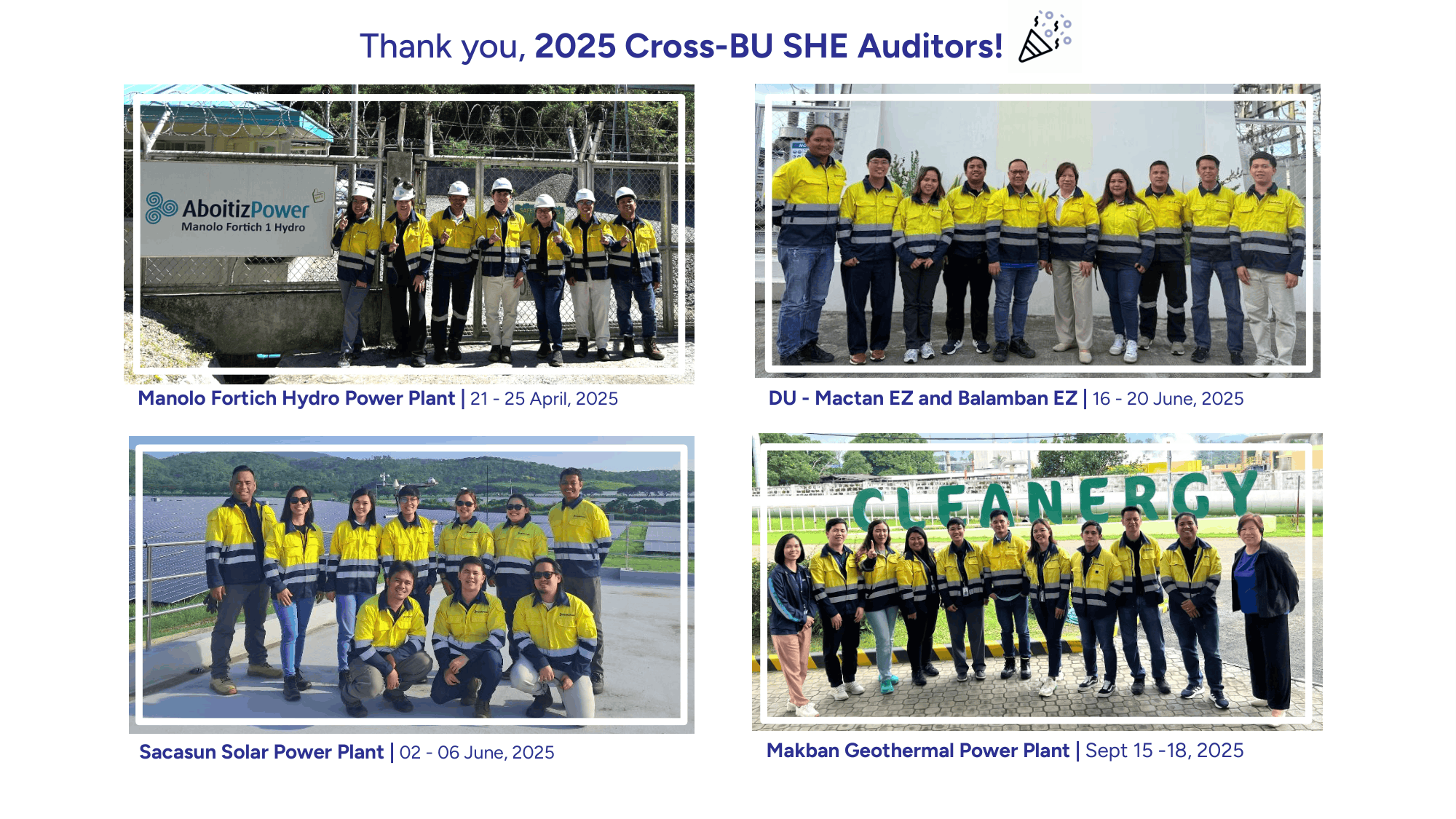
The Cross-BU SHE Audit was conducted in 2025 across 1AP’s Business Units such as, the Manolo Fortich Hydro Plant, Mactan Enerzone, Balamban Enerzone, Sacasun Solar Plant, and Makban Geothermal plant.
Learn more about our Cross-BU Safety, Health, and Environment (SHE) Audit Program here.
In 2021, AboitizPower recalibrated its data monitoring of its environmental footprint. This includes identifying and tracking the hazardous wastes generated in our facilities.
See below our data on Waste for 2023-2025:
| Waste (in metric tonnes) | 2023 | 2024 | 2025 | |
|---|---|---|---|---|
| Waste Generated | Hazardous | 2,414 | 3,742 | 1,506 |
| Non Hazardous | 314 | 378 | 1,253¹ | |
| Waste recycled or reused (including composted) | Hazardous | 240 | 1,546 | 942 |
| Non Hazardous | 62 | 154 | 700¹ | |
| Waste disposed | Hazardous | 1,689 | 647 | 711 |
| Non Hazardous | 288 | 220 | 1,141¹ |
Data Transparency: Fly ash generated, previously disclosed in this section, is excluded and reported in the table below under fly ash management.
Starting in 2021, our fly ash by-product is tagged and monitored as hazardous waste. Although initially classified as hazardous, the fly ash generated from our coal facilities is conditioned to be non-hazardous and sent to our partners for use as raw materials in cement grinding and concrete mixing.
AboitizPower strictly complies with all environmental regulations when managing fly ash and bottom ash from its coal plants. By using facility waste as a viable raw material for cement companies, AboitizPower can create a closed-loop, value-adding fly ash management system. Our coal plants have partnerships with cement companies for using fly ash as an additive in cement production.
To align with the United Nations Sustainable Development Goals, particularly to promoting sustainable industrialization, we continue to partner with various organizations and companies to develop innovative ways to use our fly ash and bottom ash, turning them into eco-bricks and other sustainable construction materials.
Our TSI and TVI facilities have the Building Resilient Infrastructure and Communities with Kaibigans (“B.R.I.C.K.”) initiative, which upcycles fly ash and plastic waste into eco-bricks, in partnership with local government units. Our GMEC plant also has its own initiative, the Cement Credits program, in which the plant partners with cement manufacturers to upcycle fly ash into sustainable building materials. As of 2024, the program has helped complete 457 classrooms in 70 schools across Bataan’s 12 municipalities.
See our data on Ash generated and recycled/reused from 2023-2025:
| Ash & Gypsum Waste (in tons) | 2023 | 2024 | 2025¹ |
|---|---|---|---|
| Total ash and gypsum waste generated | 127,132 | 96,286² | 313,597 |
| Total ash and gypsum waste recycled/reused | 139,017 | 110,628 | 306,405³ |
Data Transparency: 100% of our fly-ash generated is recycled, there’s a difference between the amount of fly ash generated and the amount recycled or reused in a given year can be attributed to timing differences between generation and collection by off-takers, as some ash remains in temporary storage prior to collection. In addition, ash conditioning increases the weight of the ash relative to the dry ash originally generated.
In our efforts to improving climate change resilience, AboitizPower and its subsidiaries have implemented initiatives and activities that promote biodiversity conservation and environmental sustainability.
Our team members’ volunteerism and partnership with our host communities, government agencies, non-government organizations, and people’s groups make these activities possible. Some of these activities include the Annual Aboitiz Group-wide simultaneous tree planting, Cleanergy Park, watershed projects, adoption of protected areas, adopt-a-river and adopt-a-marine sanctuary, agroforestry projects, and environmental rehabilitation. Aboitiz Renewables (the renewable arm of AboitizPower) conducted several environmental activities across the Philippines to celebrate Earth Month 2026. These activities included planting 1000 fruit-bearing seedlings in Barangay Buhawen, San Marcelino, Zambales, 1,000 arabica coffee seedlings were planted along Mt. Apo's Sibulan Trail in Mindanao, under the Kahoy Mo, Kinabuhi Ko (My Tree, My Life) project, and a total of 700 mangrove seedlings in Barangay Lemery and the Bacutan Pawikan Sanctuary and Mangrove Reserve.
We also adopted a female Philippine eagle named Pangarap in 2010, contributing to wildlife conservation efforts. She continues to receive essential support for her well-being, including funding for food, veterinary care, and shelter maintenance. She now serves as a distinguished ambassador for conservation education, captivating audiences with her majestic presence and inspiring stories.
As part of our environmental efforts, we have installed pollution-control devices, new technologies, and systems in our plant operations to improve our processes and optimize our resources.
Furthermore, to contribute to SDG 15 (Life on Land), the Aboitiz Group, through its A-Park program, has planted over 12 million trees across the Philippines, including 5 million from AboitizPower’s tree-planting initiatives. From 2016 to 2025 alone, we planted over 3.1 million trees in 6,633 hectares.
During these years, the company also contributed to SDG 14 (Life Below Water) through 446 coastal and river cleanup activities, resulting in the collection of 260,908kg of waste. One of these coastal cleanup efforts is called the “Scubasurero,” where AboitizPower’s Therma Visayas Inc. (TVI) works together with volunteer divers, Bantay Dagat, fisherfolk, and members of the Philippine Coast Guard and Philippine National Police, to collect submerged waste near the TVI facility and Bato Marine Sanctuary. Our subsidiary, Therma Mobile, Inc. (TMO), together with local residents and public officials, launched a community-led rehabilitation initiative for the Navotas River. Volunteers of the initiative collected 113 kilograms of segregated waste from the waterway during a clean-up activity.
Learn more about our environmental CSR initiatives here.
| Units | 2020 | 2021 | 2022 | 2023 | 2024 | 2025 | |
|---|---|---|---|---|---|---|---|
| Total trees planted | seedlings | 304,377 | 288,112 | 289,004 | 353,975 | 308,043 | 315,555 |
| Total area planted | ha | 325 | 785 | 314 | 3,124 | 291 | 214 |
| Units | 2020 | 2021 | 2022 | 2023 | 2024 | 2025 | |
|---|---|---|---|---|---|---|---|
| Total number of clean-up activities | no. of activities | 21 | 25 | 54 | 61 | 92 | 81 |
| Total number of waste collected | kg | 65,321 | 15,351 | 24,122 | 30,855 | 29,692 | 27,921 |
One of the material topics associated with the energy sector is GHG emissions. At AboitizPower, we value transparency and integrity across our operations. We are responsible for reporting the GHG footprint of our operations.
In 2021, as part of our environmental reporting recalibration, we launched and utilized a new tool for our GHG emission accounting. We also recalibrated our previous year's results to ensure that the data reported is consistent with the current year.
| GHG Emission | Units | 2020 | 2021 | 2022 | 2023 | 2024 | 2025 |
|---|---|---|---|---|---|---|---|
| GHG Emissions Intensity - Generation | tonnes CO2eq/MWh generated | 0.450 | 0.472 | 0.435 | 0.466 | 0.474 | 0.449 |
| GHG Emissions Intensity - Distribution | tonnes CO2eq/MWh sold | 0.055 | 0.064 | 0.050 | 0.059 | 0.059 | 0.061 |
Generation units included in the report are the following: AP Renewables, Inc., San Carlos Sun Power, Inc., Luzon Hydro Corp., Hedcor, Inc., Hedcor Sibulan, Inc., Hedcor, Tudaya, Inc., Hedcor Sabangan, Inc., Hedcor Bukidnon, Inc., Therma Marine, Inc., Therma Mobile, Inc., Therma South, Inc., East Asia Utilities Corporation, SN Aboitiz Power Magat, Inc., SN Aboitiz Power Benguet, Inc., Therma Power Visayas, Inc., Therma Visayas, Inc., PV Sinag Power Inc., GNPower Dinginin Ltd. Co., and GNPower Mariveles Energy Center Ltd. Co.
Distribution units included in the report are the following: Visayan Electric, Davao Light, Cotabato Light, Subic Enerzone, Mactan Enerzone, Balamban Enerzone, Lima Enerzone, and Malvar Enerzone.
As one of the Philippines’ largest energy producers, we are committed to providing the nation with reliable, affordable, and sustainable power sources.

Our investment and shareholder relations reports are available online to get a glimpse of how we address people, planet, and profit.

A productive career awaits you at AboitizPower. Look through our job listings and join us in transforming energy for a better world today!