Early this month, the Department of Energy said that it aspires to eventually power all government buildings with solar power. A week earlier, the President’s SONA mentioned powering over a million households with solar home systems and advocated streamlining the approval process of the Net Metering Program, which enables consumers with solar rooftops to sell excess power generation and earn credits. Last February, the Chamber of Automotive Manufacturers of the Philippines also projected that the annual purchase volume of electric vehicles (EVs) could hit 20,000 this year — potentially a first in the country’s history.
These aren’t just random pieces of news. These developments represent some of the areas where the energy transition is occurring and evolving. While it is imperative to understand the energy transition from the perspective of large-scale power generation and networks, as well as dominant fuel types like coal and oil, a more holistic approach is to also look at where and how energy is consumed, while appreciating the significant changes being made in those areas. To understand how a complex and large system works, one should segment or break it down into its constituent parts.
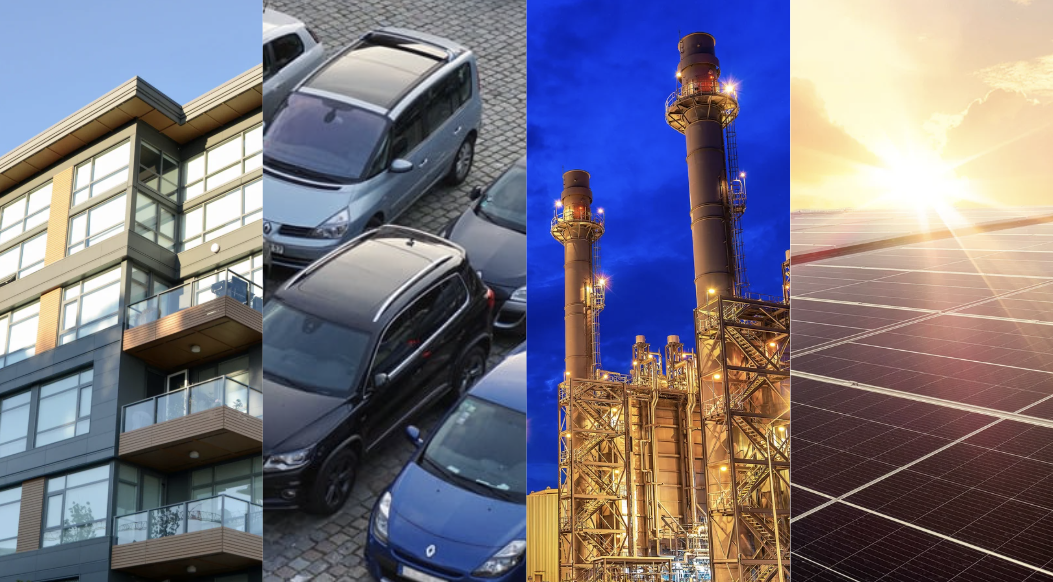
According to Shell plc, there are four pillars of the energy system, which largely depend on existing technologies as well as the capacity to absorb the cost and pace of shifting to new and better ones. Due to its intricacies and scale, the energy transition — in the fullest sense — requires coordination, appropriate government policies, and private sector support.
Buildings
This pillar pertains to aligning energy consumption with broader energy-efficiency standards and goals. Globally, residential and commercial buildings rely on various fuel types to meet demands for cooking, heating, cooling, and lighting. The International Energy Agency (IEA) found that, in 2024, global electricity consumption in the buildings sector grew four times faster than the previous year, driven by rising demand for air conditioning and new data centers, and accounted for nearly 60% of total growth in electricity consumption. With greater electrification projected to become more widespread, demand management, together with solutions like rooftop solar installations, is expected to further reduce power demand from the central grid and help abate greenhouse gas emissions.
The Philippine government is working on its Government Energy Management Program and also incentivizes private actors to improve energy efficiency in their own homes and buildings through programs like Net Metering and RCOA. In individual homes, even the use of LED lights and inverter motor-driven air conditioners and refrigerators helps decrease each family’s energy footprint. However, the diffusion of these innovations will take time, largely depending on each household’s capacity to afford the changes.
Transport
The electrification of different modes of transport — from scooters and bikes to cars, rail transit, and even long-distance freight, shipping, and aviation — will progress at different paces, representing a mixed bag of transitions within the same pillar. More time and further innovation are needed for commercially competitive solutions to materialize, especially for large aircraft and vessels. Shell plc estimates that 90% of energy demand from the transport sector is still being met by oil products due to their “high energy density, convenience, and cost competitiveness.”
While sustainable aviation fuel and LNG are being tested as alternatives in aviation and shipping, respectively, there is more headway in passenger road transport. The share of EVs in all car sales has been steadily increasing globally, from just 2% in 2018 to 14% in 2022, 18% in 2023, and 20% in 2024, according to the IEA. However, adoption of new technologies tends to be slower in developing countries. For instance, while electricity consumption in Philippine transport grew in previous years due to the operation of mass rail transit lines and more EV units sold, EVs’ proportion of total car sales remains far below the global average — just 4% in 2024 and projected at 7% in 2025. The availability of charging points for EVs is also still an issue. Nonetheless, this is perhaps the most exciting and observable transition among the four pillars.
Industry
The transition in the industry pillar also varies, with light industries such as manufacturing, mining, and agriculture being relatively easier to electrify and decarbonize. On the other hand, heavy industries like steel and cement are slower, harder, and more costly to transition due to the energy intensity of their high-temperature processes. According to the IEA, electricity use in industry grew by almost 4% in 2024, pushing it to account for nearly 40% of total growth in electricity demand. In the Philippines, industry’s energy demand in 2022 mostly consisted of electricity (34.9%) — used in almost all industrial processes such as food processing, iron and steel, and machinery and equipment industries — followed by coal (26.1%) and oil products (25.7%).
For developing countries on the path to industrialization, while natural gas and LNG are being positioned as alternatives to coal, coal will continue to play an important role in both power and non-power applications. The Philippine Energy Plan foresees industrial coal consumption growing by 4.2% annually to 2050 “due to increasing demand for building materials, particularly cement, iron, and steel that are essential for the country’s infrastructure development.”
Power
Among the four pillars, decarbonization is progressing most in power, with the share of renewables and nuclear in global electricity generation growth rising from 23.5% in 2003–2007 to 81.1% in 2024, as recorded by the IEA. But while renewables and nuclear made up 32% and 9% of global electricity generation, respectively, fossil fuels remain the largest source of power at close to 60%, as emerging markets and developing economies continue to rely on coal as their primary source.
For developing countries, zero-emission technologies have yet to fully displace fossil fuels, given the high initial costs of developing nuclear power and the intermittency of variable renewable energy sources, which require additional investments in energy storage systems and even natural gas and LNG to manage supply-demand fluctuations. Considering the energy trilemma, sustainability must be balanced with energy security and energy equity.
Overall
The energy transition isn’t limited to one pillar, nor is it the sole responsibility of any one sector or organization. It is much bigger than that. The energy transition should be viewed as a whole-of-society approach, dependent on every choice made by individuals, businesses, and governments alike. It must also be stressed that the transition within each pillar is neither simple, homogenous, nor quick. Each pillar is different, and within each one are sub-pillars that may progress faster or slower, be easier or harder, and behave more simply or more complexly than others.